December 19, 2025
Researchers from the Universitat Autònoma de Barcelona (UAB) and the University of the Witwatersrand, South Africa, working within the Catalonia Quantum Academy framework, present in Nature Photonics a comprehensive collection of the latest advances in quantum structured light, an emerging field that allows increasing the amount of information that light can transport. This technology has potential applications in more secure communications, faster quantum computing, and high-sensitivity detection systems.
An international team of scientists affiliated with the Catalonia Quantum Academy (CQA) has published in Nature Photonics a review on an emerging field that is transforming the way we communicate, measure and process information: quantum structured light. This technology combines quantum information with spatial and temporal structures of light to create photons with unprecedented information capacity.
The authors highlight how the manipulation of multiple degrees of freedom of light, such as polarization, spatial modes, and frequency, allows generating high-dimensional quantum states, where the already familiar qubits (two-dimensional, with photons in superposition of two quantum states) become qudits (with more than two dimensions).
These properties create new opportunities across multiple fields. In the field of quantum communications, security is increased, since there is a higher information capacity per photon, and the possibility of having many simultaneous communication channels is opened, with enhanced tolerance for errors and resistance to noise. In terms of quantum computing, structured light enables simpler and faster circuits, with the possibility of creating states for complex simulations. It also opens the door to significant advances in imaging and metrology, with improved resolution techniques – such as the recent development of the holographic quantum microscope, which allows obtaining images of delicate biological samples – and ultrasensitive sensors based on quantum correlations. In addition, structured light allows simulations of complex quantum systems to predict, for example, the interaction between molecules and networks, with potential for the development of new materials.
According to Professor Andrew Forbes, corresponding author from the University of the Witwatersrand, at Johannesburg, the field has changed dramatically in two decades. “The tailoring of quantum states, where quantum light is engineered for a particular purpose, has gathered pace of late, finally starting to show its full potential. Twenty years ago the toolkit for this was virtually empty. Today we have on-chip sources of quantum structured light that are compact and efficient, able to create and control quantum states.”
“Although we have made amazing progress, there are still challenging issues,” says Forbes. “The distance reach with structured light, both classical and quantum, remains very low, but this is also an opportunity, stimulating the search for more abstract degrees of freedom to exploit.”
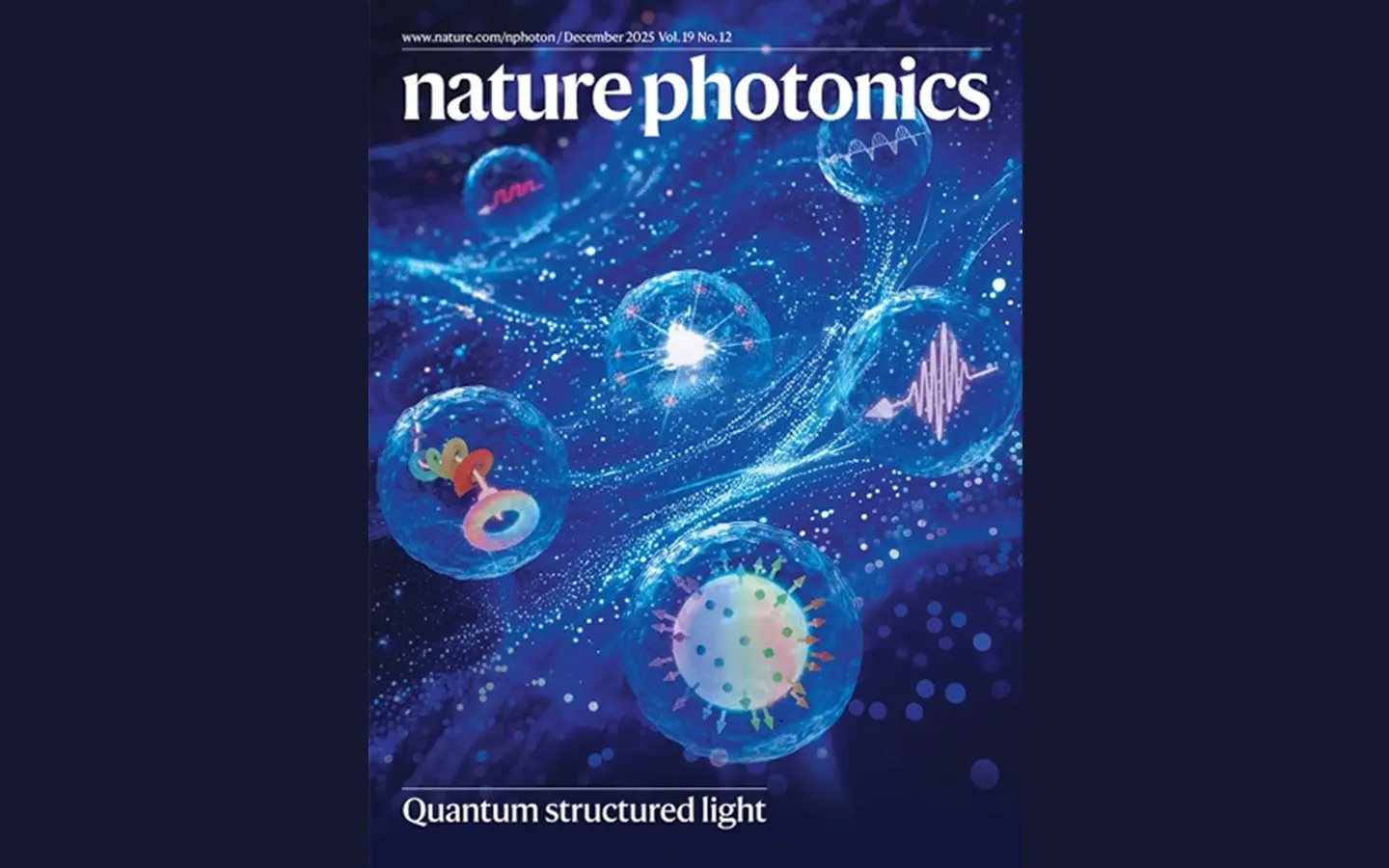
The article, featuring as the cover article in this month’s issue of Nature Photonics, is the result of a longstanding collaboration between the research group specializing in structured light, led by Professor Andrew Forbes, from the Faculty of Physics of the University of the Witwatersrand, Johannesburg, South Africa, and researcher Adam Vallés, from the Optics Group of the UAB Department of Physics and visiting scientist at the Optoelectronics group at ICFO. Their latest project, finally published as a review article, has also been possible thanks to the support of the Catalonia Quantum Academy, a collaborative platform coordinated by ICFO and promoted by the Government of Catalonia, which works to strengthen the training and development of talent in quantum sciences and technologies in Catalonia.
Reference:
Forbes, A., Nothlawala, F. & Vallés, A. Progress in quantum structured light. Nat. Photon. 19, 1291–1300 (2025). https://doi.org/10.1038/s41566-025-01795-x