
2026.07.09
- Professor Hyeon-Ho Jeong's research team develops power-free, waterproof, andmoisture-proof optical devices for autonomous driving by mimicking penguin feathers
- Removes moisture in just 6 seconds using only sunlight... Maintaining stable LiDARsignals even in adverse weather conditions
- Industrial application expected through verification of large-area fabrication technologyand durability
- Published in the international journal Nature Communications
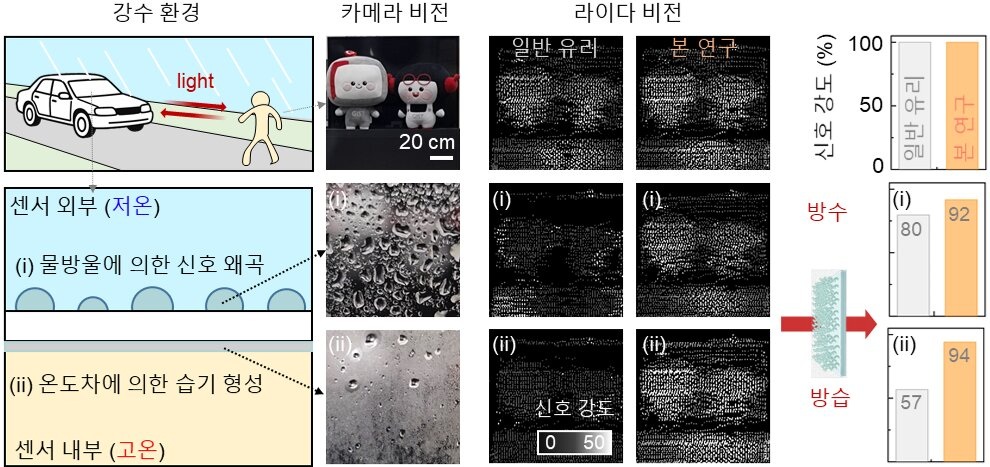
Rain and fog degrade the performance of LiDAR, which acts as the "eyes" of autonomous vehicles. Consequently, the development of protective technologies to prevent sensor performance degradation caused by moisture and rainwater is receiving significant attention.
The Gwangju Institute of Science and Technology (GIST, President Kichul Lim) announced that a research team led by Professor Professor Hyeon-Ho Jeong of the Department of Electrical Engineering and Computer Science has developed a "plasmonic helical structure*" that mimics the structure of a penguin's feather.
Utilizing this structure, the research team implemented an optical coating technology that removes moisture and repels rainwater without a separate power supply, laying the foundation for the stable reception of LiDAR signals even in adverse weather conditions.
Anti-fog and water-repellent coatings developed to date have been specialized for removing moisture or water droplets, respectively, making it difficult to implement both functions simultaneously.
Additionally, while existing photothermal coatings excel at converting sunlight into heat, they had a limitation in that they also absorbed light in the near-infrared region used by LiDAR, thereby weakening sensor signals.
In response, the research team found the solution in the structure of penguin feathers, which simultaneously maintain body temperature and provide waterproofing even in extreme environments.
Analysis of shed penguin feather samples provided by the ‘Exhibition Animal Division, Animal Management Research Laboratory, National Institute of Ecology’ confirmed that nano-sized melanosomes* within the feathers absorb light to generate heat, while the microstructure of the feather surface plays a role in inhibiting the attachment of water droplets.
Based on these principles, a plasmonic helical structure of three-dimensional silica (SiO₂) containing copper (Cu) nanoparticles was developed. This structure absorbs light to generate heat while simultaneously inhibiting the adhesion of water droplets, thereby performing both moisture removal and water-repellent functions.
The coating incorporating the plasmonic helical structure was able to rapidly remove moisture using only sunlight while maintaining a transmittance of over 80% in the near-infrared (905nm) region used by autonomous driving LiDAR.
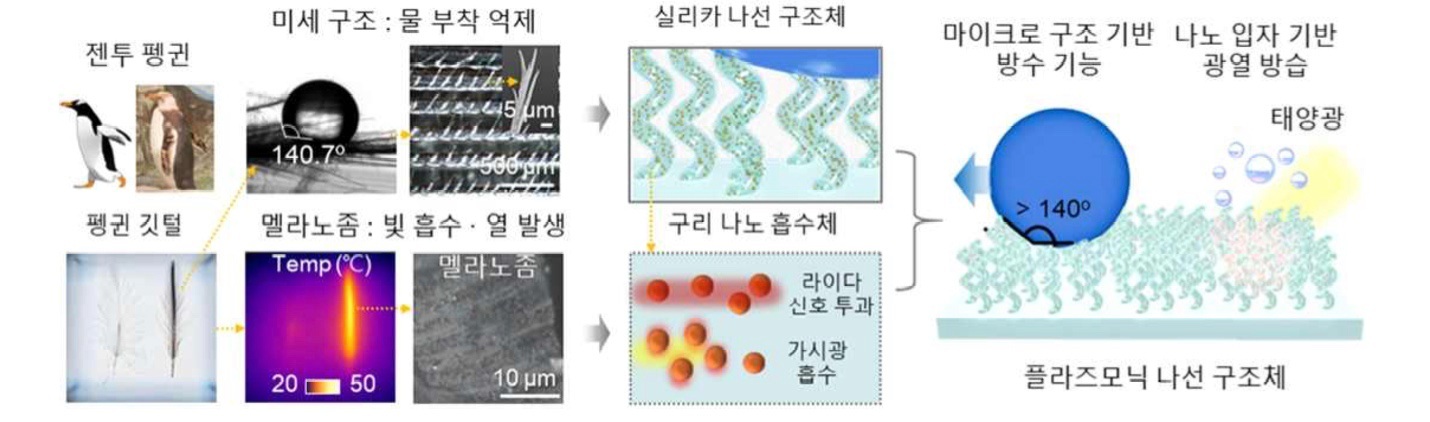
Plasmonic spiral structure mimicking the function of penguin feathers. This illustrates the principles of water adhesion inhibition and photothermal generation found in penguin feathers, as well as the waterproofing and photothermal moistureproofing capabilities of the plasmonic spiral structure that mimics these principles.
Under typical sunlight conditions, the surface temperature rose by approximately 9.3°C, and condensed moisture was removed within 6 seconds. Actual outdoor LiDAR experiments and durability evaluations also confirmed that the material maintained stable signal reception performance and excellent optical and water-repellent performance.
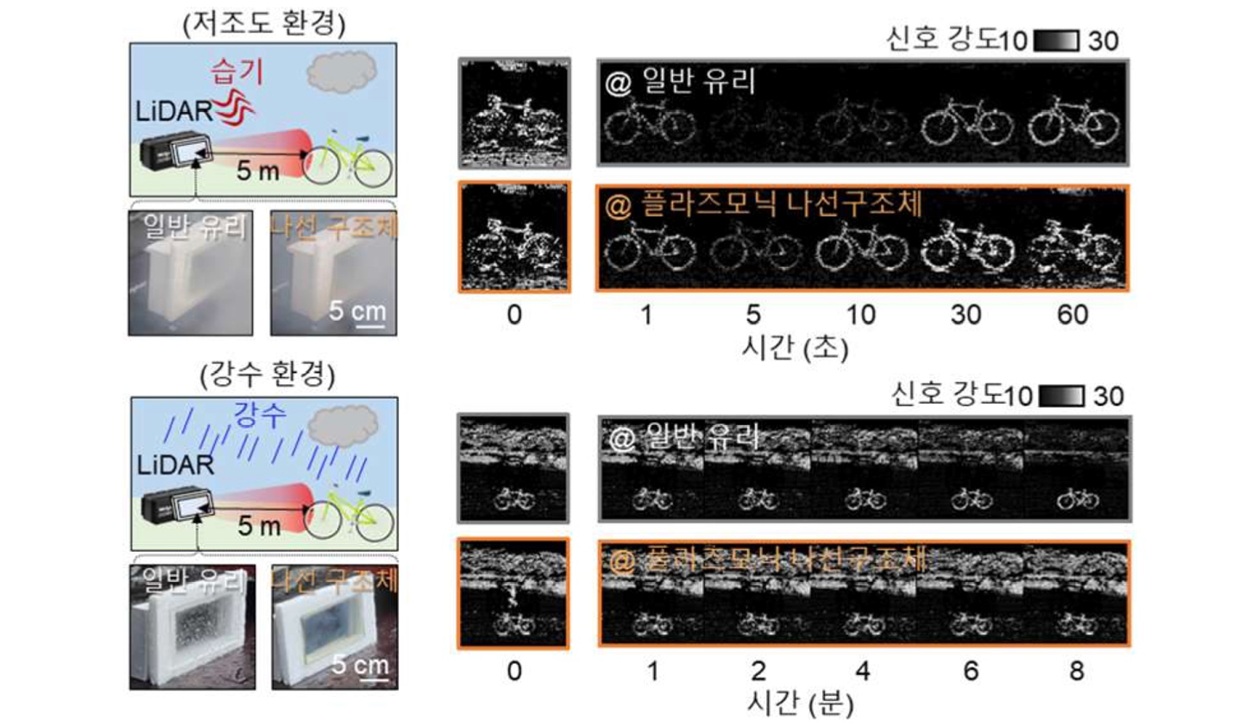
Verification of LiDAR operation performance in adverse weather conditions. LiDAR image signals from ordinary glass and the plasmonic spiral structure were compared under low-light and precipitation conditions. Through this research, the performance and durability suitable for application in actual automotive sensor covers have been secured.
Professor Hyeon-Ho Jeong stated, "We have presented a new concept of optical platform that simultaneously implements moisture removal and water-repellent functions using only sunlight, without a separate power supply, while not interfering with LiDAR signals." He added, "We expect this to be utilized in the future to enhance the stability of various outdoor optical systems, including autonomous vehicles, robots, drones, and smart windows."
The research team expressed their gratitude to the National Institute of Ecology for depositing the penguin feather samples used in this study.
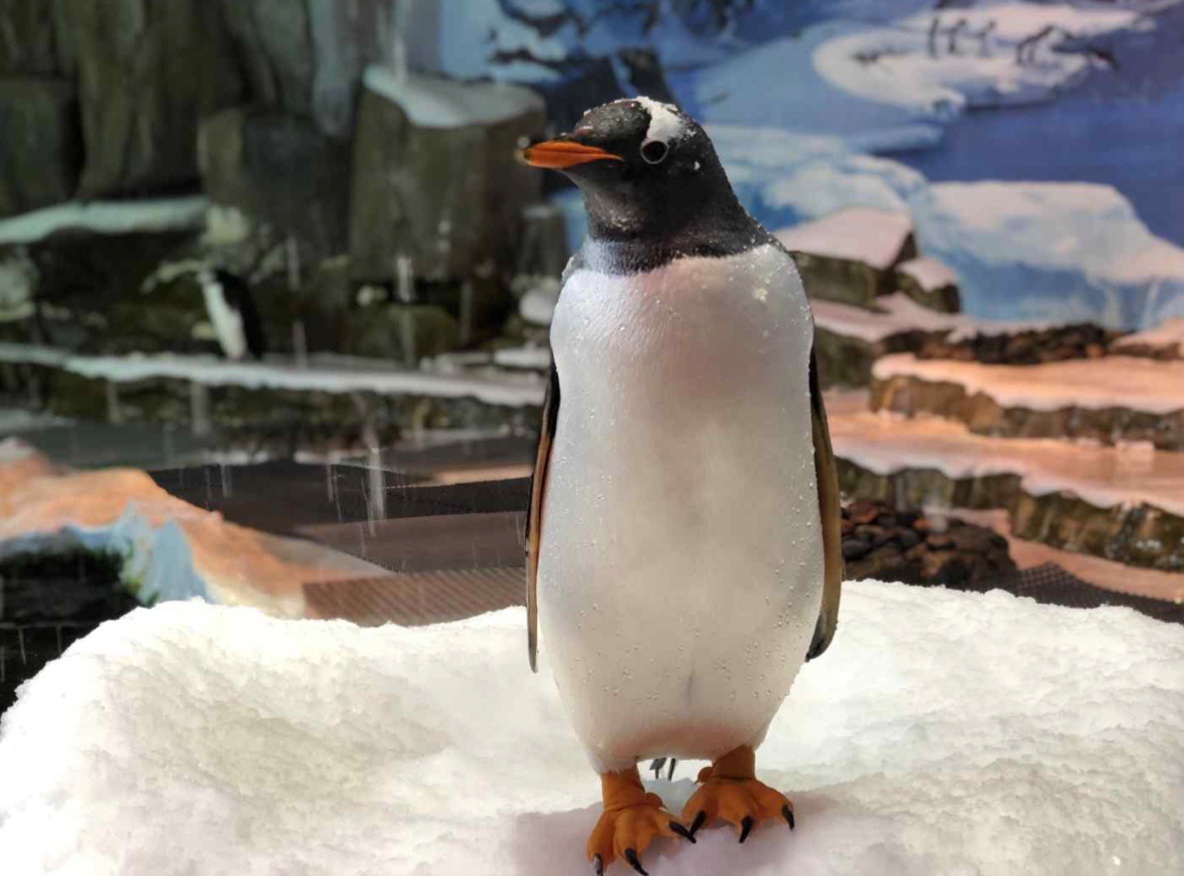
A picture of the combat penguin that provided the ‘penguin shed feather’ samples used in the study. The samples were provided by the Exhibition Animals Division of the Animal Management Research Laboratory at the National Institute of Ecology.
This research, supervised by Professor Hyeon-Ho Jeong of the Department of Electrical Engineering and Computer Science and with integrated master's and doctoral students JuHyeong Lee and Gyurin Kim participating as co-first authors, was supported by the Ministry of Science and ICT and the National Research Foundation of Korea’s Excellent Young Researcher Program, GIST research projects, and the Ministry of Science and ICT’s GIST-InnoCORE program.
The research results — Plasmonic nanocomposite helices for weather-adaptive LiDAR function — were published online in the international journal Nature Communications on June 27, 2026.
Meanwhile, GIST stated that this research achievement takes into account both its academic significance and potential for industrial application, and that discussions regarding technology transfer can be conducted through the Technology Commercialization Center.
* plasmonic helical structure: An artificial nanostructure that combines metal nanoparticles, which absorb light and generate heat, with a helical microstructure that prevents water droplets from adhering.
* melanosomes: Nano-sized pigment particles found in animal hair or feathers that absorb light to display color or generate heat.