November 18, 2026
Written by
Kimm Fesenmaier
When scientists shine a laser beam into a crystal, they typically expect a steady glow as the crystal's atoms are energized and begin to emit light. But in early 2024, while searching for something else entirely, researchers in the lab of Caltech's Andrei Faraon saw a crystal flash in a regular rhythm, like a metronome keeping a beat. The flashes came from billions of atoms embedded in the crystal. Coupled to a tiny superconducting circuit, the atoms had become synchronized and started emitting light together through a special quantum phenomenon known as superradiance.
And when the scientists took a closer look, they found something even more surprising.
"Remarkably, the atoms were flashing in two very different kinds of light at once—microwaves and infrared light—in perfect step with each other. That had not been observed before," says Faraon (BS '04), Caltech's William L. Valentine Professor of Applied Physics and Electrical Engineering and the Fletcher Jones Foundation Director of the Kavli Nanoscience Institute.
Now, working with researchers at Stanford University led by Joonhee Choi, Faraon's team has figured out what causes this synchronized flashing. They used the mechanism to create a new type of specialized laser called a superradiant frequency comb that could be more stable than other lasers.
Unlike conventional lasers that emit a single color of light, frequency combs act like a ruler for light across a range of frequencies, or colors; the spacing between neighboring colors is exactly the same, like the teeth of a comb. Frequency combs have been used to improve precise measurements of time and distance leading to improvements in atomic clocks, ultrafast science, and the identification of chemicals. The discovered superradiant frequency comb would simultaneously produce microwave and optical light, and thus could help enable links between quantum devices.
The scientists describe the superradiant frequency comb in a paper in the journal Nature. The paper's lead author, Tian Xie (PhD '25), completed the work as a graduate student in Faraon's lab and is now a postdoctoral researcher at Stanford University.
Superradiance itself is not new. Scientists have known about the emission for more than 50 years. To understand the quantum phenomenon, first consider laser light. In a laser, atoms in a material such as a gas or a crystal are excited to higher energy levels. Then light bouncing between mirrors prompts the excited atoms to release that energy in step with it, adding more light to the beam with every bounce. This process builds up coherent light—light waves with crests and troughs that are aligned with one another. The distance between the mirrors helps determine the frequency of the light. If the mirrors move even a miniscule amount, the frequency will also change.
Something different happens with superradiance: There are no mirrors to coordinate the light. Instead, the individual atoms lock into step on their own through a shared electromagnetic field and then radiate together. Previous work has shown that clouds of such synchronized atoms can emit a quick superradiant flash or a steady beam at a frequency determined by the atoms themselves rather than the distance between mirrors.
The Caltech and Stanford researchers were surprised to see that instead of a single flash or a steady beam, the synchronized atoms could be made to fire in a repeated regular rhythm to produce a frequency comb.
"Imagine a crowd suddenly starting to clap in perfect rhythm without anyone leading them. That's essentially what these atoms are doing when they produce repeated flashes of light, and it's remarkable that they can organize themselves this way," says Choi, now an assistant professor at Stanford University and formerly a postdoctoral scholar at Caltech.
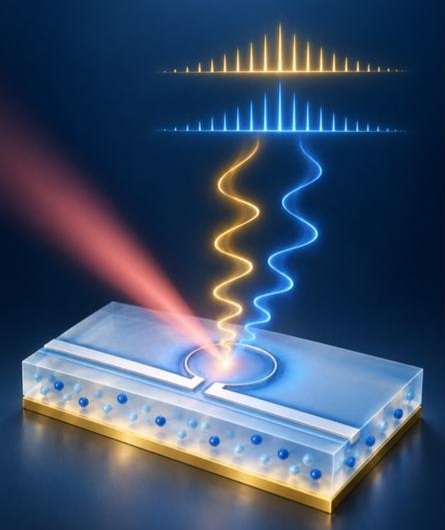
The researchers embedded billions of ytterbium ions, charged atoms, within a yttrium orthovanadate crystal located beneath a tiny microwave resonator—in this case, a layer of superconducting material that trapped the microwaves. When a laser energized the ions, they emitted microwaves. Since all the ytterbium ions experienced the same microwave field, they influenced one another and became synchronized, emitting light steadily. But past a certain laser power, the ions switched from emitting steadily to pulsing in rhythm.
"Other mode-locked frequency combs depend on bouncing light off mirrors in a cavity, and those cavity lengths can fluctuate due to things like temperature," Xie says. "Because superradiance comes from atom–atom interference, it's absolutely frequency-stable, and therefore it can, in principle, be a much better platform than previous frequency combs."
The researchers would like to learn how to adjust and shape the rhythm of the superradiant pulsing at will, "so that the atoms become a kind of programmable light source," Faraon says. By tuning the properties of the atoms with the laser light, the team should be able to naturally change the emission properties of the resulting frequency comb. "Being able to tune each emission strength, pulse separation, and emission format would be very useful to suit each specific application," he says.
Beyond improved frequency combs, the work holds promise for linking quantum devices. One common strategy for quantum computers uses superconducting circuits that work with microwaves. But microwaves lose their quantum information easily if they are not kept at ultralow temperatures, near absolute zero (about minus 460 degrees Fahrenheit). Optical light, by contrast, can carry information over long distances through fiber cables, but superconducting circuits cannot directly send or receive optical light.
Ytterbium ions, though, can interact with both microwave and optical light. The ions, Xie explains, have three discrete energy levels; there is a small gap, or transition, between two of the energy levels, and a larger gap between another pairing. The energy required to jump across the small gap corresponds to the emission or absorption of microwave light, while the jump across the larger gap involves optical light. Since the same ion has both gaps, it can interact with both frequencies of light.
"Whenever these ions generate a microwave field, there is a process that naturally generates a corresponding optical field at the same time," Xie says. "That's why in the experiment, you send a laser light to pump the atoms and you see two emissions coming out at very different frequencies."
This suggests it might be possible to use the microwave emission to interface with superconducting hardware and the optical emission to enable information to be carried long distances.
The paper is titled "Observation of Tunable Superradiant Frequency Combs." Additional authors of the paper are former Caltech graduate student Rikuto Fukumori (PhD '26) and current graduate students Wai Keong Mok and Jiahui Li (MS '24). The work was primarily funded by the Office of Naval Research with additional support from the Institute of Quantum Information and Matter (IQIM), the US Department of Energy, the Co-design Center for Quantum Advantage, and the Gordon and Betty Moore Foundation Experimental Physics Investigators. Individual researchers were supported by the Air Force Office of Scientific Research, the Terman Faculty Fellowship at Stanford University, the Quad Fellowship, and the Eddleman Fellowship. Fabrication was performed in the Kavli Nanoscience Institute at Caltech.